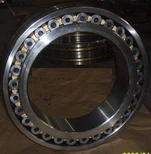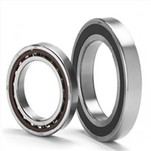


A crossed roller bearing, also called a crossed roller slideway, is effectively two sets of bearings and races combined at right angles to each other. Cylindrical bearings or rollers mount along the length of a rail in a carriage. The rollers are held in place with a cage, preventing roller-to-roller contact, which increases friction and wear. Keeping rollers separated also eliminates any risk of them jamming.
If you were to number the cylindrical rollers along the rail, the even ones would be mounted at 90° to the odd ones. In other words, the rollers alternate orientation. This lets the line of alternating rollers support loads from all directions, including high overturning moments, and because they do not recirculate like some ball bearings that line linear rails, all the rollers are constantly carrying the load except for pure radial loads, where, due to the criss-cross arrangement, only half of the rollers take loads at any one time.
The cylindrical rollers are mounted such that they create a protruding V-shape on the sliding rail. It fits into a corresponding V notch in the other rail that is likely carrying the load.
Rollers provide a full line of contact rather than just the point of contact a ball bearing provides. This gives crossed roller bearing a broader contact surface and the ability to carry heavier loads. It also increases the bearing’s rigidity so it deforms less and is thus more accurate. Plus, erosion is slower due to the crossed rollers’ consistency of contact between the carriage and the base.
There is a direct correlation between the combined contact area of all the rollers and load capacity: the greater the area, the higher the capacity. This lets bearing designers adjust load capacity by up to 250% by mounting rollers closer together. This permits more rollers to fit in the same space and increases the amount of weight per inch the bearing can carry.
Cross roller bearing do not use seals due to their construction, high precision, and low friction. Still, it is important to keep contaminants away from the rollers to prevent damage and wear. One way this is done, especially in IC manufacturing and lab equipment, is to install the machines using crossed roller bearings in clean, contamination-free environments.
It is also important to lubricate crossed roller bearings to get the most operational life out of them. A standard lubricant for them is lithium-soap-based #00 grease.
The configuration of crossed roller bearings gives designers all the benefits of a two-row bearing, including stability, in a single-row space.