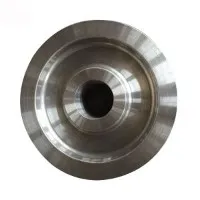


Shell mill-Modular principle

A face mill shell. The rectangular cutout area on the back side is the pocket that engages the lugs/tangs of the arbor.
A shell mill is any of various milling cutters (typically a face mill or endmill) whose construction takes a modular form, with the shank (arbor) made separately from the body of the cutter, which is called a "shell" and attaches to the shank/arbor via any of several standardized joining methods.
This modular style of construction is appropriate for large milling cutters for about the same reason that large diesel engines use separate pieces for each cylinder and head whereas a smaller engine would use one integrated casting. Two reasons are that (1) for the maker it is more practical (and thus less expensive) to make the individual pieces as separate endeavors than to machine all their features in relation to each other while the whole unit is integrated (which would require a larger machine tool work envelope); and (2) the user can change some pieces while keeping other pieces the same (rather than changing the whole unit). One arbor (at a hypothetical price of USD100) can serve for various shells at different times. Thus 5 different milling cutters may require only USD100 worth of arbor cost, rather than USD500, as long as the workflow of the shop does not require them all to be set up simultaneously. It is also possible that a crashed tool scraps only the shell rather than both the shell and arbor. This would be like crashing a "regular" endmill and being able to reuse the shank rather than losing it along with the flutes.
Most shell mills made today use indexable inserts for the cutting edges—thus shank, body, and cutting edges are all modular components.