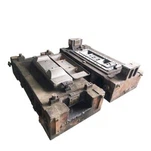


Mould is the most widely used basic process equipment in industrial production. Mould industry is the basic industry of the national economy. In modern industrial production, product parts are widely used in stamping, forging, die-casting, extrusion, plastic injection or other forming and processing methods. They are matched with forming dies to form blanks into parts that meet product requirements. The various tools and products we use in our daily production and life, from the base of the machine tool and the shell of the machine to the shell of a head screw, button and various household appliances, are all closely related to the mold. The shape of the mold determines the shape of these products, and the processing quality and accuracy of the mold determines the quality of these products. In recent years, the mold industry has developed rapidly. Graphite materials, new processes and increasing mold factories have continuously impacted the mold market. Graphite has gradually become the material of choice for mold making due to its good physical and chemical properties.
At present, graphite molds have been widely used in the following areas:
Graphite mold for non-ferrous metal continuous casting and semi-continuous casting
In recent years, domestic and foreign countries are promoting advanced production methods such as direct continuous (or semi-continuous) manufacturing of rods or pipes from the molten metal state. China has begun to adopt this method in copper, copper alloy, aluminum, aluminum alloy and other aspects. Artificial graphite is considered as the most suitable material as a mold for continuous casting or semi-continuous casting of non-ferrous metals. Production practice proves that due to the use of graphite molds, due to its good thermal conductivity (the thermal conductivity determines the solidification speed of metals or alloys), and the mold's self-lubricating performance is good, etc. Accurate, smooth surface, uniform crystal structure, can be directly processed in the next process. This not only greatly improves the yield rate and reduces the loss of waste products, but also significantly improves the product quality. There are two continuous casting methods: vertical continuous casting and horizontal continuous casting.
Die for pressure casting
Artificial graphite materials have been successfully used in the pressure casting of non-ferrous metals. For example, zinc alloy and copper alloy castings produced by pressure casting molds made of artificial graphite materials have been used in automotive parts and the like.
Graphite mold for centrifugal casting
Graphite molds have been successfully applied to centrifugal casting. The United States has used artificial graphite molds with a wall thickness of 25 mm or more to centrifugally cast bronze sleeves. In order to prevent burning of the artificial graphite mold, certain anti-oxidation measures can be taken. After casting a certain number of castings, if the inner surface of the mold is found to be damaged, the size of the inner hole of the mold can be enlarged to be used for casting large-size casing.
Hot pressing die
The artificial graphite hot-pressing mold has the following characteristics for the pressure sintering of hard alloys: First, if the pressing temperature is increased to 1350-1450 degrees, the required unit pressure can be reduced to 67-100 kgf / cm (That is, 1/10 of the cold pressing pressure). Second, pressurization and heating are performed in the same process, and a dense sintered body can be obtained after a short time sintering.
Glass mould
Because graphite materials have chemical stability, they are not easy to be infiltrated by molten glass, do not change the composition of glass, graphite materials have good thermal shock resistance, and their size changes with temperature. They have become indispensable molds in glass manufacturing in recent years. Materials, it can be used to make glass tubes, elbows, funnels and other various shaped glass bottles.
Sintering molds and other diamond sintering molds
The use of artificial graphite materials with minimal thermal deformation can be used to manufacture sintered molds and brackets for transistors, which are now widely used. It has become an indispensable material for the development of the semiconductor industry. In addition, graphite molds are also used in molds for cast iron, durable molds for various non-ferrous metals, molds for cast steel, molds for heat-resistant metals (titanium, zirconium, molybdenum, etc.) and aluminum for welding rails. Heat-welded molds, etc. Graphite molds for hot-pressed sintered diamond tools bear the dual role of heating elements and mold support during the manufacturing process of diamond tools. The quality of graphite molds directly affects the dimensional accuracy and appearance of diamond tools. Hot pressing sintering process requirements: The temperature reaches (1 000 ± 2) ° C, the forming pressure is 16 to 50 MPa, the heat preservation and holding time is 15 to 30 minutes, and the environment is non-vacuum. Under this working condition, graphite molds for forming and heating elements are required to have conductivity, high resistivity, and sufficient mechanical strength, as well as good oxidation resistance and long service life to ensure diamond Tool dimensional accuracy and excellent performance. At present, graphite mold materials used for diamond tool manufacturing in developed countries in the West are mainly ultrafine particle structure, high purity and high graphitization degree graphite materials. The average particle size is required to be less than 15 μm, even less than 10 μm, and the medium pore size is less than 2 μm. A graphite mold made of this carbon raw material has a small porosity, a dense structure, a high surface finish, and strong oxidation resistance. The average service life is 30 to 40 times. Diamond molds require high material hardness, good oxidation resistance, and high processing accuracy. The use of high-quality graphite raw materials greatly extends the life of the mold and improves the oxidation resistance.