


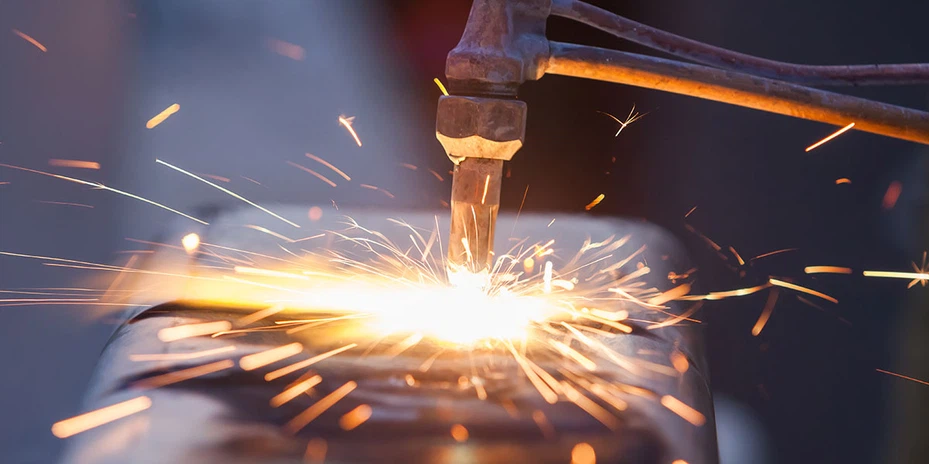
1. Manual arc welding
Manual arc welding is the earliest developed and still the most widely used welding method among various arc welding methods. It uses an externally coated welding rod as the electrode and filler metal, and the arc burns between the end of the welding rod and the surface of the workpiece to be welded. The coating can generate gas under the action of arc heat on the one hand to protect the arc, and on the other hand it can generate slag to cover the surface of the molten pool to prevent the interaction between the molten metal and the surrounding gas. The more important function of slag is to react physically and chemically with the molten metal or add alloying elements to improve the properties of the weld metal.
2. Gas tungsten arc welding
This is a non-melting electrode gas shielded arc welding, which uses the arc between the tungsten electrode and the workpiece to melt the metal to form a weld. The tungsten electrode does not melt during the welding process and only functions as an electrode. At the same time, argon or helium gas is fed into the nozzle of the welding torch for protection. Additional metal can be added as needed. (Internationally known as TIG welding).
3. Gas tungsten arc welding
This is a non-melting electrode gas shielded arc welding, which uses the arc between the tungsten electrode and the workpiece to melt the metal to form a weld. The tungsten electrode does not melt during the welding process and only functions as an electrode. At the same time, argon or helium gas is fed into the nozzle of the welding torch for protection. Additional metal can be added as needed. (Internationally known as TIG welding).
4. Plasma arc welding
Plasma arc welding is also a type of non-melting arc welding. It uses a compressed arc (called forward transferred arc) between the electrode and the workpiece to achieve welding. The electrode used is usually a tungsten electrode. The plasma gas used to generate the plasma arc can be argon, nitrogen, helium or a mixture of the two. It is also protected with inert gas through the nozzle. Filler metal may or may not be added during welding.
5. Tubular wire arc welding
Tubular wire arc welding also uses the arc burning between the continuously fed wire and the workpiece as the heat source for welding. It can be considered a type of gas metal arc welding. The welding wire used is a tubular welding wire, and the tube is filled with flux of various components. When welding, additional protective gas is added, mainly CO2. The flux decomposes or melts when heated, and plays the role of forming slag to protect the molten pool, infiltrating the alloy and stabilizing the arc.
6. Resistance welding
This is a type of welding method that uses resistance heat as energy, including electroslag welding that uses slag resistance heat as energy and resistance welding that uses solid resistance heat as energy. Since electroslag welding has unique characteristics, it will be introduced later. Here we mainly introduce several types of resistance welding using solid resistance heat as energy source, including spot welding, seam welding, projection welding and butt welding.
7. Electron beam welding
Electron beam welding is a method of welding using the heat energy generated when a concentrated high-speed electron beam bombards the surface of the workpiece. During electron beam welding, an electron beam is generated and accelerated by an electron gun. Commonly used electron beam welding include: high vacuum electron beam welding, low vacuum electron beam welding and non-vacuum electron beam welding. The first two methods are performed in a vacuum chamber. The welding preparation time (mainly vacuuming time) is long, and the size of the workpiece is limited by the size of the vacuum chamber.
8. Laser welding
Laser welding is a welding process that uses a laser beam focused by high-power coherent monochromatic photon flow as a heat source. This welding method usually includes continuous power laser welding and pulse power laser welding.
9. Brazing
The energy source for brazing can be chemical reaction heat or indirect heat energy. It uses a metal with a lower melting point than the melting point of the material to be welded as the solder. After heating, the solder is melted, and the capillary action draws the solder into the gap of the joint contact surface, moistening the surface of the metal to be welded, so that the liquid phase and Interdiffusion between solid phases forms a brazed joint. Therefore, brazing is a solid phase and liquid phase welding method.
10. Electroslag welding
Electroslag welding is a welding method that uses the resistance heat of molten slag as energy. The welding process is carried out in the vertical welding position, within the assembly gap formed by the end surfaces of the two workpieces and the water-cooled copper sliders on both sides. During welding, the resistance heat generated by electric current passing through the slag is used to melt the end of the workpiece. According to the shape of the electrode used during welding, electroslag welding is divided into wire electrode electroslag welding, plate electrode electroslag welding and molten nozzle electroslag welding.
11. High frequency welding
High-frequency welding uses solid resistance heat as energy source. During welding, the resistance heat generated by high-frequency current in the I piece is used to heat the surface layer of the welding area of the I piece to a molten or close to plastic state, and then upsetting force is applied (or not applied) to achieve the bonding of the metals. Therefore it is a solid phase resistance welding method.
12. Gas welding
Gas welding is a welding method that uses gas flame as the heat source. The most widely used flame is the oxyacetylene flame using acetylene gas as fuel. Because the equipment is simple and easy to use, gas welding heating speed and productivity are low, the heat affected zone is large, and it is easy to cause large deformation.


