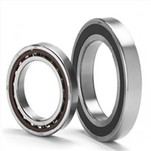


The rotary kiln tyre, also known as the rolling ring, is one of the main components of the rotary kiln. The function of the wheel tyre is to transfer the entire gravity of the cylinder (including the gravity of the refractory bricks, internal devices and materials) to the supporting wheel, and enable the simplified body to smoothly rotate on the supporting wheel, so the wheel tyre must have sufficient strength and Durability. At the same time, the wheel tyre is a part that strengthens the radial rigidity of the cylinder and should have sufficient rigidity. Due to the influence of heat, care must be taken in design to reduce the temperature stress in the tyre.
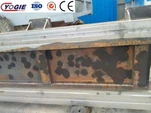
1. The outer surface of the rotating kiln equipment wheel has scales peeling, pitting, cracking, crushing and so on. On the contact surfaces of the tyre and the roller, a large contact stress is generated due to the large load. Therefore, when it is in operation, surface fatigue damage occurs due to repeated action of contact stress.
Generally, in the old kiln that has been in operation for two or three decades, it is common to produce honeycomb-like pitting on the tyre. After repairing the defects of the tyre, the difference in hardness between the repaired portion and the heat affected zone and the metal matrix is too large. It is often easy to make the whole repair welding part fall off. The casting quality of the wheel tyre is not good, and it is easy to cause cracking and crushing of the wheel tyre.
2, premature wear. In use, due to the skew of the rotary kiln support wheel or the inconsistent subsidence of the pivot points of the rotary kiln, the axis of the rotary kiln tyre and the idler wheel are not parallel, and the local contact stress is increased, so that the cylindrical wheel tyre is ground into a saddle shape and a waist drum. Shape, cone, etc. In the design, if the material and hardness of the wheel and the roller are improperly selected, it will cause premature wear.
3. Cracks appear on the radial section of the wheel. Due to the large load, the wheel has a bending stress in its radial section. At the same time, the temperature difference between the inner and outer walls of the rotary kiln wheel also generates temperature stress on the radial section of the wheel (if in the hot state, stress is generated between the wheel and the cylinder, the tension on the radial section of the wheel will increase) . Furthermore, if the tyre annealing is incomplete, casting stress is generated therein. The superposition of these three causes cracks or even breaks in the radial section of the wheel.
4. The rotary kiln tyre has insufficient rigidity. The stiffness of the wheel tyre has a great influence on the radial stiffness of the cylinder, which is a prerequisite for prolonging the life of the rotary kiln refractory brick and should be accounted for.
From the above-mentioned damage pattern of the rotary kiln wheel, it is known that the bending stress, temperature stress, contact stress and rigidity of the section are calculated and checked during the design of the wheel tyre.