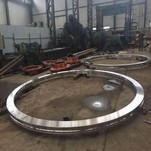


Main processing method of gear rack
Gear rack processing method: (1) hobbing (2) gear shaping (3) shaving (4) grinding (5) honing.
Hobbing
Use the gear hob to process the tooth surface of gears, worm gears, etc. according to the development method.
The principle of processing gears with a gear hob on a hobbing machine is equivalent to the principle that a pair of helical gears mesh.
The hob is essentially a helical gear with a large helix angle, because the number of teeth is very small (the number of teeth of a single-head hob K=1), and the teeth are very long, which can make many turns around the axis, so it becomes a small helix angle Worm-the basic worm of the hob. After grooving and shoveling, the worm becomes a gear hob with a cutting edge and front and back angles.
The gear hob and the processed gear, when the hob rotates, it is equivalent to a rack moving in the axial direction. This movement is equivalent to the meshing movement of the imaginary rack and the gear being processed, so there is between the hob and the gear being processed. The following requirements:
(1) The normal modulus of the hob mn cutter and the normal tooth profile angle αon cutter should be equal to the corresponding parameters of the gear to be processed.
(2) The hob and the gear to be processed must strictly maintain the motion relationship of a pair of helical gears, namely:
Where n-knife-speed of hob per minute;
n work——workpiece speed per minute;
z work-the number of teeth of the workpiece;
K-the number of hobs.
(3) In order to make the spiral direction of the hob coincide with the tooth direction of the gear to be processed, the hob axis should be inclined by an installation angle γ A to the end face of the gear. When hobbing a straight tooth cylindrical gear, γ A = λ f, where λ f It is the spiral angle of hob. When hobbing a helical gear, γ ampere = βf ± λf, where βf is the helix angle of the gear to be processed. When the spiral direction of the hob and the workpiece are opposite, the "+" sign is taken, and when the hob is the same, the "-" sign is taken.
When hobbing, in addition to the rotation of the hob (cutting motion) and the developing motion between the hob and the workpiece, the hob also needs to have a knife movement δ axis along the workpiece axis. These three motions constitute the hob Basic movement of teeth.
These three basic motions are also necessary when hobbing helical gears, but because the teeth of helical gears are helical along the tooth width, it requires the hob to rotate the S axis in the axial direction while the workpiece also has to rotate. That is, when both the workpiece and the hob are required to strictly maintain the developed motion relationship, and the hob is required to move the cutter axially to a lead T of the workpiece, the workpiece has an additional motion of one revolution or one revolution.
Hobbing is the most commonly used gear cutting method. It can process straight, helical and modified cylindrical gears. The hobbing precision can generally reach 7 to 8 levels, and the highest precision can reach 4 to 5 levels, or even 3 levels. Since the entire cutting process of the hobbing is continuous, the productivity is high.
Gear shaping
Use the gear shaping tool to process the tooth surfaces of the internal and external gears or racks according to the forming method or the forming method.
The gear shaping and hobbing are also processed by the forming method. The gear shaper is like a gear with a front and back angle to form the cutting edge, so the principle of the gear shaper machining gear is equivalent to the principle of a pair of cylindrical gears with two parallel axes.
During the gear shaping, the gear shaping cutter performs the reciprocating cutting motion of up and down. The cutting speed is expressed by the number of double strokes per minute. Similarly, the gear shaper and the gear to be processed must maintain a kinematic relationship of meshing with a pair of cylindrical gears, namely:
In the formula, n-knife, n-work—the speed of gear shaping knife and workpiece;
z knife, z work-the number of teeth of the gear shaping knife and the workpiece.
At the beginning of gear shaping, in order to gradually cut to the full tooth depth, the gear shaping cutter must have a radial feed movement. The radial feed amount δ diameter is expressed by the number of radial feeds of the gear cutter for each double stroke. When cutting to the adjusted depth, the radial feed stops by itself. The radial feed process and feed amount are generally controlled by the cam.
In the reciprocating motion of the gear shaper, the cutting motion is downward, and the empty stroke is upward. In order to avoid scratching the machined tooth surface and reduce the wear of the gear shaping cutter during the idle stroke, the workpiece needs to have the cutter movement of the gear shaping cutter.
The gear shaping accuracy can generally reach 7 to 8 grade, and the highest precision can reach 6 grade.