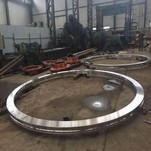


When a pair of gears is finished, the gears will have a certain degree of elastic deformation after the gears are engaged. Therefore, when one tooth is engaged, the load of the original meshing teeth is relatively reduced. They will immediately return to the load position to deform, which gives the gear body a tangential acceleration, plus the bending deformation of the original meshing teeth under the load and the gear manufacturing error, so that the gear teeth can be engaged from the whole to the teeth. In the process, the smooth contact of the theoretical tooth profile can not be obtained and the collision occurs, forming a so-called meshing impact force. Under this excitation, the gear will also excite the circumferential vibration, radial vibration and axial vibration of the gear, thereby generating noise. And through the air and solid medium propagation, the wiring impact force and the meshing impact force generated during the gear meshing process cause the vibration generated by the pair of transmission gears, which is called the main cause of the noise.
When describing the mechanism for generating gear vibration and noise, the gear can be regarded as a spring-mass vibration system, the gear teeth are regarded as springs, and the gears are regarded as masses, and the line impact force and the meshing impact force can be regarded as External force, which causes the gear to generate vibration in the circumferential direction, and through the shafting, the bearing induces radial and axial vibration of the gear. The vibration in these three directions is transmitted to the gear box through the shaft, bearing and bearing housing, causing vibration of the casing wall. Even induced vibrations from the entire device, radiated into the air to become gearbox noise.