


The Stakes of Heavy Parts
Heavy machinery parts - gears, shafts, gear rings, housings, buckets, wear components - do a demanding job. They carry heavy loads, run in dusty, abrasive, shock-loaded conditions in mining, cement, construction and material handling, and a failed part can stop an entire line. Unlike a small consumer component, a heavy part is expensive to ship, slow to replace, and hard to correct once it fails in service. Choosing a manufacturer is therefore not just about price; it is about finding a partner whose parts will hold up in those conditions.
A cheap part that fails early costs far more than the saving. The right supplier is one that can consistently deliver the material, the geometry and the inspection evidence behind each part. The question is how to tell that supplier apart from a broker or a workshop that quotes well but cannot deliver.
Experience with Similar Parts
The quickest filter is experience. A manufacturer that has already made parts like yours - same material, same weight range, same kind of load - has already solved the problems your part will pose. Ask for actual case examples, drawings of comparable components, and references from customers in the same industry. A shop that claims "high precision" and "any material" but cannot show a single similar part is a red flag, however good the website looks.
Heavy parts also come from different processes: casting, forging, fabrication and machining each suit a different geometry. A reliable supplier should be honest about which process your part needs rather than forcing everything through whichever process it happens to run. If your gear ring needs forging and your housing needs welding and machining, look for a manufacturer that controls or coordinates the whole route, not just one operation.
Real Manufacturing Capability
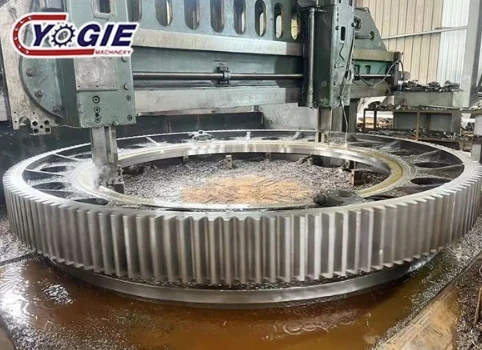
Look past the brochure to what the factory actually has. For heavy work, that means large-capacity forging presses or melting and casting equipment, big CNC lathes, gantry and horizontal machining centers that can swing or travel the size of your part, and heat-treatment capability. The supplier should be able to tell you the maximum part weight, swing and machining envelope it handles, and should be making comparable sizes already.
Control matters as much as equipment. A supplier that does casting or forging in-house and also finishes machining it has fewer hand-offs and better control over tolerances between the rough form and the finished part. If it buys forgings in and only machines them, ask where the forgings come from and how the incoming material is verified. The more the supplier controls the process chain, the more accountable it is for the finished part.
Quality System and Traceability
Reliability in heavy parts is backed by a documented quality system, not by good intentions. At minimum look for an established quality-management certification, and for industries such as mining, cement, lifting or export, additional third-party or industry certifications that your customers or insurers may require. Just as important is traceability: for load-bearing parts, the material must be traceable from the heat - mill certificates, material test reports, and records tying each finished part back to its material batch.
Ask how changes are controlled. A supplier that can tell you how it handles an engineering change, a material substitute or a nonconforming part is one that will not quietly swap steel grades or alter a process. For safety-critical components, this audit trail is what makes the part defensible if something is ever questioned in service.
Inspection and Testing Equipment
A manufacturer can only hold what it can measure. Inspect what inspection equipment the factory actually owns, not just what it promises: coordinate measuring machines for dimensional checks, hardness testers, and - for load-bearing castings and forgings - non-destructive testing such as ultrasonic, magnetic-particle or dye-penetrant inspection. For heavy steel parts, internal soundness is as important as external dimensions, and the supplier should run NDT and share the reports.
Request inspection documentation with shipments: dimensional reports, material certificates, heat-treatment records and NDT results. A supplier that routinely provides these, rather than producing them only when demanded, is one whose quality system is real. Spot-audit or visit the factory when volume or criticality justifies it; the inspection room and the foundry tell more than any presentation.
Capacity, Lead Time and Communication
A capable manufacturer is useless if it cannot deliver when your line needs the part. Confirm that its current load leaves room for your order, and ask realistic lead times for a sample and for repeat orders. Heavy parts often take weeks through forging or casting, heat treatment and machining, and a supplier that under-promises and then slips repeatedly disrupts maintenance planning.
Communication is part of reliability too. The supplier should respond in plain language, understand your drawings and requirements, flag problems early rather than after delivery, and treat a drawing review as a conversation. Cross-border buyers should also consider language, time zone, export packaging and shipping experience - a part that is machined well but arrives damaged or undocumented is still a failure.
Why Choose Us
We manufacture heavy machinery parts for mining, cement, construction and material-handling equipment, including forged and cast gear rings, gears, shafts, housings and wear components, finished on large CNC lathes, gantry and horizontal machining centers. Material traceability, heat treatment and non-destructive testing are built into the process, and parts are supplied with inspection and material reports.
Conclusion
Selecting a reliable heavy machinery parts manufacturer comes down to evidence: real experience with similar parts, genuine equipment that can handle your size and material, a documented quality system with full material traceability, inspection and NDT capability it can actually show you, and the capacity and communication to deliver on time. The cheapest quote rarely wins once you factor in a failed early part and a stopped line.
The right supplier acts as a manufacturing partner - reviewing your drawings, recommending the right process, and standing behind the parts with certificates and reports. Choose on proven track record and quality evidence rather than price alone, and your heavy parts will keep running in the conditions they were built for.


