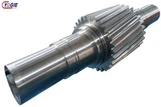


Luoyang Yujie Industry&Trade Co., Ltd is one of the most experienced manufacturers and suppliers of high quality forging steel wind power shaft ,wind turbine shaft in China. Please feel free to buy cheap high quality forging steel wind power shaft ,wind turbine shaft for sale here from our factory. All customized products are with high quality and competitive price.
Products Description
A wind turbine shaft is a critical component of a wind turbine system that helps convert wind energy into mechanical energy and eventually electrical energy. It is a long, cylindrical structure that connects the turbine's rotor blades to the generator, allowing the rotational energy from the blades to be transferred to the generator for electricity generation. The shaft is subjected to significant mechanical stress due to the forces generated by wind and the rotational motion of the rotor blades.
materials
Common materials for fan shafts include high-quality carbon steel, alloy steel, stainless steel, ductile iron and high-strength gray cast iron.
High-quality carbon steel: such as 25-45 high-quality carbon steel, 40Cr or 45Cr high-quality structural steel, etc. These materials have good comprehensive mechanical properties and are inexpensive and widely used.
Alloy steel: For important shafts with large forces, large sizes and complex shapes, alloy quenched and tempered steels with better comprehensive mechanical properties can be selected for manufacturing, such as 40Cr, 40MnVB, etc. For shafts with extremely high requirements, nitriding steel (such as 38CrMoAlA) should be used.
Stainless steel: The fan main shaft is made of stainless steel, which is mainly used to connect the fan wing and the fan base. Its axial offset is directly transmitted to the input shaft of the gearbox.
Ductile iron and high-strength gray cast iron: These materials have good stiffness and wear resistance, and have the advantages of low notch sensitivity, vibration reduction and friction reduction, good machinability and low production cost, and are suitable for cost-sensitive applications.
When selecting the material of the fan shaft, it is necessary to comprehensively consider factors such as specific working conditions, precision requirements and bearing types. For example, for lightly loaded non-important shafts, in order to reduce costs, carbon steel (such as 45 steel), ductile iron (such as QT700-2), or even ordinary carbon structural steel (such as Q275) can be used for manufacturing. For shafts with wear resistance as the main requirement, steel with a higher carbon content (such as 65Mn, 9Mn2V) or low carbon steel (20Cr, 220CrMnTi) can be used for carburizing. For shafts with extremely high precision requirements, 38CrMoAlA nitriding should be selected.
roles of a wind turbine
Energy Transmission: The primary role of the wind turbine shaft is to transmit the rotational energy generated by the spinning rotor blades to the generator. As the blades are turned by the force of the wind, the shaft transfers this mechanical energy to the generator, which then converts it into electrical energy.
Connection between Rotor and Generator: The wind turbine shaft connects the rotor hub and blades to the generator. It serves as the intermediary that links the mechanical motion of the rotating blades to the electrical components of the generator.
Speed Adjustment: The wind turbine rotor blades usually rotate at a lower speed than what's optimal for electricity generation. The wind turbine shaft is often connected to a gearbox that increases the rotational speed, allowing the generator to produce electricity more efficiently.
Load Distribution: The shaft distributes the mechanical loads generated by the wind and the rotor blades evenly along its length. This helps prevent excessive stress on any one part of the turbine and ensures a balanced distribution of forces.
Support and Alignment: The shaft is supported by bearings that allow it to rotate smoothly. These bearings also help maintain proper alignment between the rotor and the generator components.
Fatigue Resistance: The shaft must be designed to withstand cyclic loading caused by continuous rotation and changing wind conditions. Proper design and material selection are essential to ensure long-term fatigue resistance.
others
Technical data:
|
Name |
Technique |
Material |
Dia/mm |
Wall thickness |
Length/mm |
|
Forging shaft |
Forging+turning+grinding |
alloy steel |
200-2000 |
---- |
500-60000 |
|
Hollow shaft |
Forging+drilling+turning |
150-800 |
≥15mm |
≤17000 |
|
|
Shaft sleeve |
Forge+drill & bore+turning +milling |
400-3000 |
≥15mm |
≤18000 |
|
|
cylinder |
Forging+drill & bore+ turning |
300-5000 |
≥10mm |
≤10000 |
|
|
Other parts in deep-hole |
Forge+ drill & bore+turning+mill |
300-5000 |
---- |
≤20000 |
Packaging & Delivery
|
|
Export standard package or according to customer requirement |
|
Delivery Detail: |
45~60days according to various quantity |
Hot Tags: high quality forging steel wind power shaft ,wind turbine shaft, manufacturers, supplier, factory, customized, cheap, price, in stock, for sale, Shaft used for Vessel, Shaft with groove, Forging Pinion Shaft, Custom Large Gear Shaft, Shaft, Wind power shaft