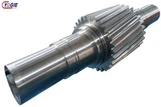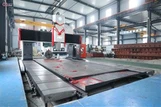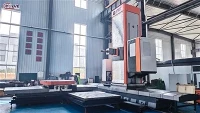


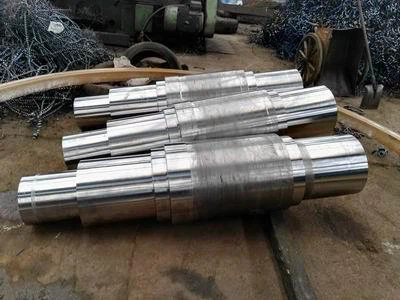


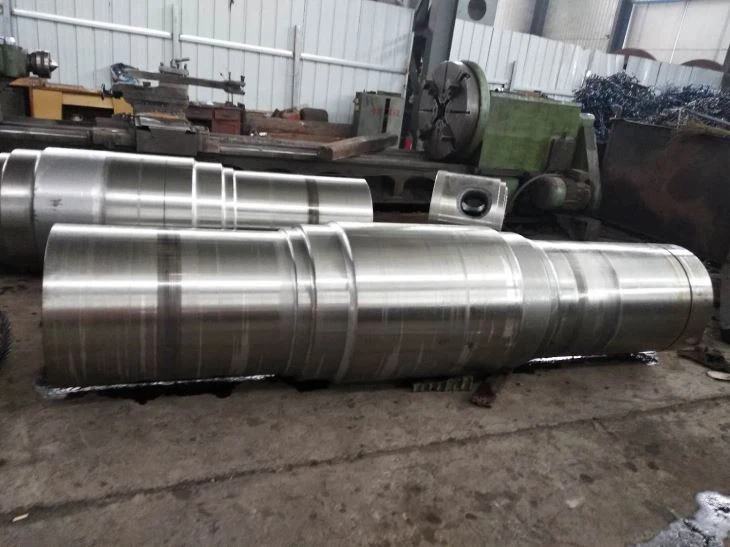
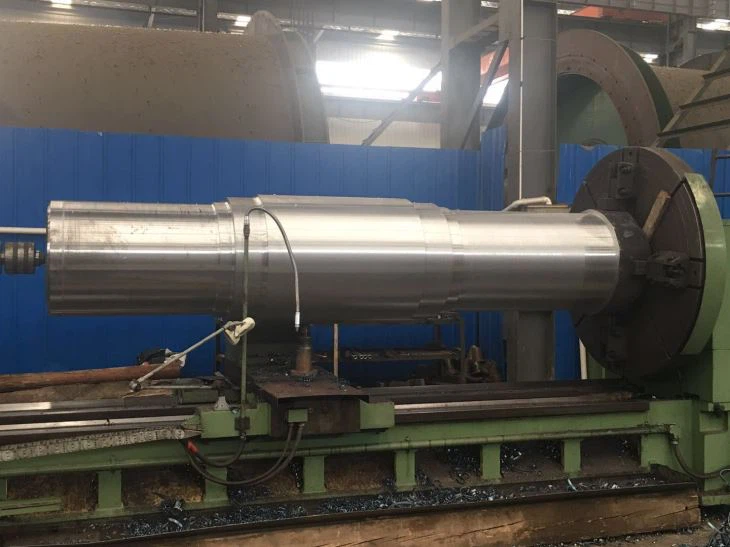
Luoyang Yujie Industry&Trade Co., Ltd is one of the most experienced manufacturers and suppliers of forged mill roller shaft in China. Please feel free to buy cheap forged mill roller shaft for sale here from our factory. All customized products are with high quality and competitive price.
Forged Mill Roller Shaft
Products Description
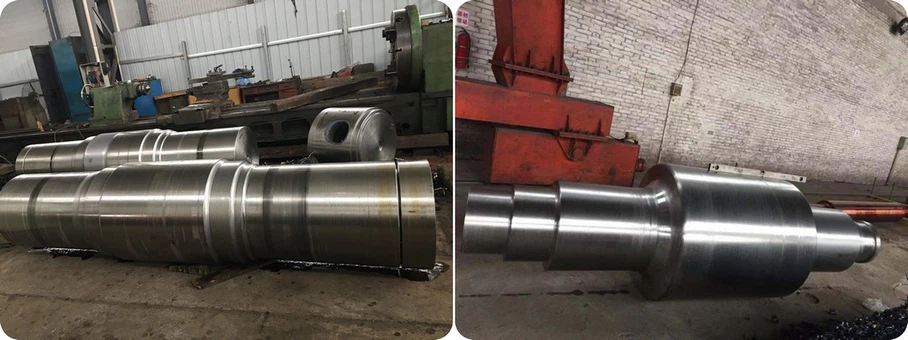
A forged mill roller shaft is a cylindrical component that supports and rotates the rollers in a rolling mill. The shaft typically has a large diameter and is made of high-strength steel to withstand the heavy loads and stresses involved in the rolling process.
The mill roller shaft is typically mounted on bearings at each end to allow for smooth rotation of the rollers. The bearings may be of various types, including spherical roller bearings, tapered roller bearings, or cylindrical roller bearings.
The shaft may also be equipped with various types of seals to prevent contaminants from entering the bearing area and to retain lubrication. These seals may include labyrinth seals, V-ring seals, or lip seals.
Products Show
Features of forged mill roller shaft
►High strength: Mill roller shafts are made of high-strength steel to withstand the heavy loads and stresses involved in the rolling process.
►Large diameter: The shaft has a large diameter to provide sufficient strength and stability to support the rollers and the load they carry.
►Precision machining: Mill roller shafts are precisely machined to ensure proper alignment of the rollers and to minimize vibration and noise during operation.
►Bearing supports: The shaft is mounted on bearings at each end to allow for smooth rotation of the rollers. The bearings may be of various types, including spherical roller bearings, tapered roller bearings, or cylindrical roller bearings.
►Sealing: The shaft may be equipped with various types of seals to prevent contaminants from entering the bearing area and to retain lubrication.
►Surface treatments: The surface of the shaft may be treated with various coatings or finishes to enhance its wear resistance and corrosion resistance.
►Maintenance: Proper maintenance of the mill roller shaft is essential to ensure efficient and reliable mill operation, including regular lubrication, inspection, and replacement of worn or damaged components.
Functions of forged mill roller shaft
★Supporting the rollers: The mill roller shaft supports the rollers in the rolling mill and provides the necessary stability to carry the weight of the material being rolled.
★Rotating the rollers: The shaft rotates the rollers to apply the necessary pressure to the material being rolled and to ensure consistent and uniform thickness and surface finish.
★Transmitting power: The shaft transmits power from the driving mechanism to the rollers, which drives the rolling process.
★Absorbing shock and vibration: The shaft absorbs shock and vibration from the rolling process to prevent damage to the rollers and other components.
★Supporting bearings: The shaft provides a support structure for the bearings that allow for smooth rotation of the rollers.
★Providing sealing: The shaft may be equipped with various types of seals to prevent contaminants from entering the bearing area and to retain lubrication.
★Maintaining alignment: The shaft ensures proper alignment of the rollers to prevent uneven wear and tear and maintain optimal rolling performance.
Summary
Overall, the mill roller shaft is a critical component in the operation of a rolling mill, and its proper function is essential to ensure efficient and reliable mill operation.
Advantages of forged mill roller shaft

►Improved efficiency: The use of mill roller shafts can improve the efficiency of the rolling process by providing smooth and consistent rotation of the rollers, which reduces energy consumption and increases productivity.
►Longer lifespan: Mill roller shafts are typically made of high-strength steel and are designed to withstand the heavy loads and stresses involved in the rolling process, resulting in a longer lifespan and reduced maintenance costs.
►Reduced downtime: Proper maintenance of the mill roller shaft can help to prevent unexpected breakdowns and reduce downtime, which can improve the overall productivity of the rolling mill.
►Increased product quality: The use of mill roller shafts can help to improve the quality of the finished product by providing consistent and uniform pressure to the material being rolled, resulting in a more uniform product thickness and surface finish.
►Flexibility: Mill roller shafts can be designed to meet the specific requirements of different rolling processes, making them a versatile component that can be adapted to a variety of production needs.
Processing of forged mill roller shaft
The machinery processing of a mill roller shaft typically involves several steps to ensure the shaft is manufactured to the required specifications. Here's a general outline of the process:
Design and Engineering: The first step is to design the mill roller shaft based on the specific requirements and parameters of the mill. This involves determining the dimensions, material selection, load-bearing capacity, and other factors.
Material Preparation: Once the design is finalized, the appropriate material for the roller shaft is selected. Common materials used for mill roller shafts include high-quality alloy steel or cast iron. The chosen material is then prepared by cutting it to the required length.
Turning: The next step is turning the raw material on a lathe machine. Turning involves rotating the material against a cutting tool to remove excess material and achieve the desired diameter and shape. The shaft is machined to the required dimensions, including diameter, length, and any specific features such as keyways or threads.
Heat Treatment: After turning, the shaft may undergo heat treatment to enhance its mechanical properties. Heat treatment processes like quenching and tempering are commonly used to improve hardness, strength, and durability.
Grinding: Grinding is often performed to ensure a smooth surface finish and precise dimensional accuracy. Specialized grinding machines are used to grind the shaft's outer diameter, inner diameter, and any other critical surfaces.
Surface Treatment: Depending on the application, the shaft may undergo surface treatment processes like polishing, coating, or plating to enhance its corrosion resistance or wear resistance.
Quality Control: Throughout the entire manufacturing process, quality control measures are implemented to ensure the shaft meets the required standards. This involves inspecting the dimensions, surface finish, hardness, and other relevant parameters.
Assembly and Testing: Once the mill roller shafts are manufactured, they can be assembled into the mill, where they will support the rollers and facilitate the milling process. The assembly is thoroughly tested to ensure proper functionality and alignment.
It's important to note that the actual process may vary depending on the specific requirements, size, and complexity of the mill roller shaft. Different manufacturers may have their own variations or additional steps in the process.
Work principles
Power Transmission: The mill roller shaft is connected to a power source, such as an electric motor or a hydraulic system. The rotational power generated by the power source is transmitted to the shaft.
Roller Support: The forged mill roller shaft supports the weight of the rollers and provides a stable platform for their rotation. The shaft is typically positioned horizontally and supported by bearings at each end. The bearings allow the shaft to rotate freely while minimizing friction and wear.
Torque Transmission: As the shaft rotates, it transfers torque to the rollers through a series of gears or couplings. This torque is essential for driving the rollers and enabling the rolling process.
Load Handling: Forged mill roller shafts are designed to withstand heavy loads imposed by the rolling process. The shaft material is carefully selected to ensure high strength, durability, and resistance to fatigue. Forging provides superior mechanical properties to the shaft, making it capable of handling the required loads and maintaining structural integrity.
Precision and Alignment: Proper alignment of the shaft and rollers is crucial for efficient and accurate rolling. Precise machining and assembly techniques are employed to ensure the concentricity and alignment of the shaft and associated components. This alignment minimizes vibrations, improves product quality, and extends the lifespan of the equipment.
Summary
In summary, forged mill roller shafts are critical components in rolling mills and metal forming processes. They transmit power and torque, support the rollers, handle heavy loads, and ensure precise rotation and alignment. These shafts are designed and manufactured to withstand the demanding conditions of the steel and metal industry, contributing to efficient and high-quality production.
About US

Luoyang Yujie Industry &Trade Co.Ltd located in Luoyang City, one of the main heavy industrial bases in China. We specialize in the production of nonstandard machinery parts. For the nonstandard machine parts, we can produce gears, shafts, sprockets, molds, rollers, pulley, mining machine parts, etc as per customer drawing and requirements.
Contact US
Do you have any specific questions about the manufacture of mill roller shaft or shaft? Contact Yogie! Our sales engineers will work with you from start to finish to ensure that your project is completed to your requirements.
Also, Yogie is a professional manufacturer for mining equipment, CNC Machine tools, and machinery parts for over 20years.

tel: +86-379-65163600

phone: +86-15036387078

envelope: sales@yujieindustry.com

fax:+86-379-65163600

address:No.9, Sanxi Road, Jianxi Industrial Park, Luoyang City, Henan, China 471003

whatsapp: 8615036387078
Hot Tags: forged mill roller shaft, manufacturers, supplier, factory, customized, cheap, price, in stock, for sale, Wind power shaft, Forging Pinion Shaft, precision machining, Custom Large Gear Shaft, Shaft with groove, Shaft used for Vessel