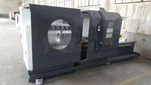


Basic composition of CNC lathe
The CNC lathe is composed of CNC device, bed, headstock, tool post feed system, tailstock, hydraulic system, cooling system, lubrication system, chip conveyor and other parts.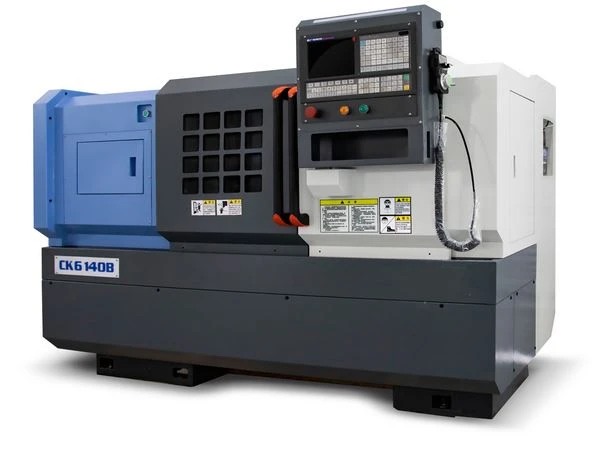
CNC lathes are divided into two types: vertical CNC lathes and horizontal CNC lathes.
Vertical CNC lathes are used for turning disk parts with larger turning diameters.
Horizontal CNC lathes are used for turning processing of parts with long axial dimensions or small disks.
Horizontal CNC lathes can be further divided into economical CNC lathes, ordinary CNC lathes and turning machining centers according to their functions.
Economical CNC lathe: A simple CNC lathe formed by reforming the turning feed system of an ordinary lathe with a stepping motor and a single-chip computer. The cost is low, the degree of automation and functions are relatively poor, and the machining accuracy of turning is not high. It is suitable for turning machining of rotary parts with low requirements.
Ordinary CNC lathe: a CNC lathe that is specially designed in structure according to the requirements of turning processing and is equipped with a general CNC system. The CNC system has strong functions, high degree of automation and machining accuracy, and is suitable for turning processing of general rotary parts. This CNC lathe can simultaneously control two coordinate axes, namely the x-axis and the z-axis.
Turning center
Turning machining center: On the basis of ordinary CNC lathes, a C axis and power head are added. More advanced machine tools also have a tool magazine, which can control the three coordinate axes of X, Z and C. The linkage control axis can be (X, Z), (X, C) or (Z, C). Due to the addition of the C-axis and milling power head, the processing functions of this CNC lathe are greatly enhanced. In addition to general turning, it can also perform radial and axial milling, surface milling, and holes and diameters whose centerline is not at the center of rotation of the part. Drilling and other processing of holes.
Hydraulic chuck and hydraulic tailstock
Hydraulic chuck is an important accessory for clamping workpieces during CNC turning. Ordinary hydraulic chucks can be used for general rotary parts; special chucks are required for parts whose clamping parts are not cylindrical; use bar materials directly A spring chuck is required when machining parts. For parts with a large ratio of axial size to radial size, it is necessary to use a live center mounted on a hydraulic tailstock to support the tail end of the part to ensure the correct processing of the part. The tailstock has ordinary hydraulic tailstock and programmable hydraulic tailstock.
Universal tool holder
The CNC lathe can be equipped with two tool holders:
①Special tool holder: developed by the lathe manufacturer, the tool holder used is also special. The advantage of this tool holder is low manufacturing cost, but lacks versatility.
②Universal tool post: A tool post produced according to certain general standards (such as VDI, German Engineers Association). CNC lathe manufacturers can choose and configure according to the functional requirements of the CNC lathe.
Milling power head
After the milling power head is installed on the tool post of the CNC lathe, the processing capacity of the CNC lathe can be greatly expanded. Such as: Use the milling power head to perform axial drilling and milling of axial grooves.
Tools for CNC lathes
When turning parts on a CNC lathe or a turning machining center, the position of the tool on the tool holder should be reasonably and scientifically arranged according to the tool holder structure of the lathe and the number of tools that can be installed, and attention should be paid to avoid the tool when the tool is stationary and working. Interference phenomenon with machine tool, tool and workpiece, and tool.
Machine tool composition
The host is the main body of the CNC machine tool, including the machine body, column, spindle, feed mechanism and other mechanical components. It is a mechanical part used to complete various cutting processes.
Numerical control device is the core of CNC machine tool, including hardware (printed circuit board, CRT display, key box, paper tape reader, etc.) and corresponding software, used to input digital part program, and complete the storage of input information and data Transformation, interpolation calculation and realization of various control functions.
The driving device is the driving part of the CNC machine tool actuator, including the spindle drive unit, feed unit, spindle motor and feed motor. He realizes the spindle and feed drive through the electric or electro-hydraulic servo system under the control of the numerical control device. When several feeds are linked, the processing of positioning, straight line, plane curve and space curve can be completed.
Auxiliary devices, some necessary supporting parts of index-controlled machine tools to ensure the operation of CNC machine tools, such as cooling, chip removal, lubrication, lighting, monitoring, etc. It includes hydraulic and pneumatic devices, chip removal devices, exchange tables, CNC turntables and CNC indexing heads, as well as cutting tools and monitoring and testing devices.
Programming and other ancillary equipment can be used to program and store parts outside the machine.
Since the Massachusetts Institute of Technology in the United States developed the world's first CNC machine tool in 1952, CNC machine tools have been widely used in the manufacturing industry, especially in the automotive, aerospace, and military industries. CNC technology is used in both hardware and software. , Both have rapid development.