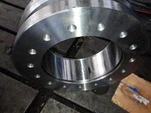


The cross roller bearing is a special type bearing with inner ring division and outer ring rotation. Since the divided inner ring or outer ring is fixed to the cross roller collar after being loaded into the roller and the spacer, it is easy to install the cross roller collar when installing the cross roller collar. Since the rollers are arranged crosswise, only one set of cross roller collars can bear the load in all directions. Compared with the conventional models, the rigidity increases by 3 to 4 times. At the same time, because the inner ring or outer ring of the cross roller bearing is a two-part structure, the bearing clearance can be adjusted, and even if preload is applied, high-precision rotation can be achieved. Moreover, due to its special structure, it is commonly used as a joint bearing in industrial robots.
Their rollers are arranged at right angles to each other at intervals between the inner and outer wheels. They can take loads from all directions (such as axial, thrust or momentum loads) simultaneously. Due to the linear contact between the roller and the track surface, the bearing is less likely to be elastically deformed by the load. This type of bearing is widely used in industries such as industrial robots, work machines and medical facilities, and it needs high rigidity, compactness, and high rotational speed to ensure accuracy.
In the cross roller bearing, because the cylindrical rollers are arranged perpendicularly to each other through the spacer, one cross roller bearing can bear loads in all directions such as radial load, axial load, and moment load. The size of the inner and outer rings is minimized, the extremely thin type is a compact size that is close to the limit, and has high rigidity. Therefore, it is most suitable for a rotary table or a rotary table of a robot or a machining center of an industrial robot. Rotary parts of robots, precision rotary tables, medical devices, gauges, IC manufacturing equipment, etc.