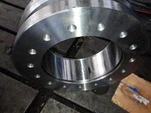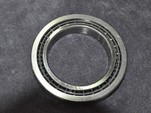


Rotary kiln tyre is usually a single steel casting, machined to accurately circular dimensions and with a mirror-smooth texture on all surfaces. Early tyres were occasionally produced as half-sections that could be easily assembled and replaced, but this was very soon abandoned because of the resulting rapid and erratic wear at the joints.
In the standard design, the rotary kiln tyre was mounted loosely on the kiln shell. Inevitably, the rotary tyres are cooler than the kiln shell, and so a small gap allows differential expansion to take place. The gap is usually designed to be about 0.2% of shell diameter at normal operating temperature. The kiln tube bears down upon the inside of the rotary tyre through smooth-surfaced chairs which also have lugs bracketing the rotary tyre, preventing it from slipping along the kiln axially. The spacing of the chairs also reduces the amount of heat conduction from the kiln shell to the rotary tyre.
The rotary tyre needs to remain relatively cool because so large a casting would be unlikely to survive a large radial temperature differential during heating up of the rotary kiln. Another effect of the gap is that rotary tyres would gradually precess around the rotary kiln, with one complete turn in every 500 turns of the kiln. Measuring the rate of precession was a rough-and-ready way of assessing the width of the expansion gap while the kiln was in operation. Small changes due to wear could be adjusted by adding shims.