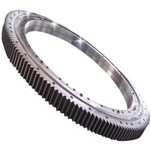


First, the characteristics of plain bearings:
1, long life, suitable for high speed.
2, can withstand the impact and vibration load.
3, running high precision, work balance, no noise.
4, simple structure, easy assembly and disassembly.
5, carrying capacity, can be used for heavy load occasions.
6, non-liquid friction sliding bearings, large friction loss; liquid friction sliding bearings, friction loss and rolling bearings are similar, but the design, manufacture and lubrication require a higher maintenance.
Second, rolling bearings:
Features:
1. The friction coefficient of the rolling bearing is smaller than that of the sliding bearing, and the transmission efficiency is high. General sliding bearing friction coefficient of 0.08-0.12, while the friction coefficient of the rolling bearing is only 0.001-0.005;
2. Rolling bearings have been standardized, serialized, universal, suitable for mass production and supply, use and maintenance is very convenient;
3. Rolling bearings made of bearing steel, and after heat treatment, therefore, the rolling bearing not only has high mechanical properties and long service life, and can save the manufacture of plain bearings used in the more expensive non-ferrous metals;
4. Rolling bearing internal clearance is small, high precision machining of all parts, therefore, high precision operation. At the same time, the rigidity of the bearing can be increased by means of preloading. This is very important for precision machinery;
5. Some rolling bearings can bear radial load and axial load simultaneously, therefore, can simplify the bearing support structure;
6. As the rolling bearing transmission efficiency, less heat, therefore, can reduce the consumption of lubricants, lubrication maintenance is more convenient;
7. Rolling bearings can be easily applied to uranium in any orientation in space.
Species:
1, according to the bearing direction can be divided into radial bearings (to bear the radial force and not a lot of axial force), thrust bearings (only axial force) and radial thrust bearings (to both radial and axial force).
2, according to the shape of the rolling body can be divided into ball bearings, roller bearings and needle roller bearings.
3, according to working conditions can be divided into ordinary bearings, high-speed bearings, high temperature bearings, low temperature bearings, vacuum bearings, magnetic bearings, corrosion-resistant bearings, precision micro-bearings and extra large bearings. China divided all types of rolling bearings into five precision grades B, C, D, E and G, B the highest precision grade, G the ordinary precision grade and the most common application.
Third, compare the two:
Compared with the plain bearings, the advantages of rolling bearings:
1, under normal conditions, the efficiency of rolling bearings and liquid-powered lubricated bearings, but higher than the mixed lubrication of bearings;
2, the radial clearance is relatively small, the contact angle to the center of the bearing preload available preload can eliminate clearance, high running accuracy;
3, for the same size of the shaft diameter, the width of the rolling bearing smaller than the sliding bearings, the machine can make the axial structure compact;
4, most of the rolling bearings can be both radial and axial load, so the bearing combination of simple structure;
5, less lubricant consumption, easy to seal, easy to maintain;
6, do not need useful non-ferrous metals;
7, a high degree of standardization, mass production, low cost.
Compared with the plain bearing, the disadvantage of rolling bearings:
1. Rolling bearing load capacity than the same size of the sliding bearings is much smaller, so the radial size of the rolling bearing. Therefore, in the case of heavy load and require small radial size, compact structure requirements (such as the engine crankshaft bearings), the use of multi-sliding bearings;
2. Rolling vibration and noise larger, especially in the late use is particularly significant, therefore, the high precision, but also not allowed to have vibration, rolling bearing difficult to perform, the general use of sliding bearings better
3. Rolling bearings are particularly sensitive to foreign objects such as metal shavings. Once inside the bearing, foreign matter can cause large intermittent vibration and noise, which can also cause early damage. In addition, the rolling bearing is also susceptible to early damage due to metal inclusions and the like. Even without early damage, the life of rolling bearings also have some limits. In short, the life of rolling bearings shorter than sliding bearings.