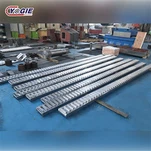


This is why spline shafts are so advantageous
Gears and splines may appear identical at first glance due to the fact that they all contain teeth. To transfer torque, they all rotate and mesh with another tooth assembly. These two mechanical elements, however, cannot be interchanged. What sets them apart?
Let's look at the most evident distinction between these two fundamental machine components:
Gears are adaptable since they employ one tooth at a time.
Gears are classified as bevel gears, helical gears, spur gears, worm gears, and so on. These varieties are further divided based on the orientation of their axis-intersecting axis, non-intersecting axis, or parallel axis. They work by employing one tooth at a time to mesh with one tooth of another gear, regardless of their design or size. As a result, they are extremely efficient and can transfer large torque levels.
They are, however, inapplicable when the shaft is in any way far.
Spline shafts have reduced fatigue because they employ all of the grooves.
To mesh with the teeth of its counterparts, the spline shaft employs all of its teeth (side teeth, straight teeth, involute or saw teeth). To function properly, both the exterior and internal splines should have the same number of ridges or teeth and be evenly distributed around the shaft. The weight is equally distributed along the sides of the spline shaft's teeth as it spins. As a result, as compared to gears, its teeth experience less force while transmitting the same amount of power. However, this is a benefit because it limits allows for a restricted number of applications.
Do you have any specific questions about the Spline shafts? Contact Yogie! Our sales engineers will work with you from start to finish to ensure that your project is completed to your requirements.
Also, Yogie is a professional manufacturer for Mining equipment, CNC Machine tools, and Machinery parts for over 20years.