


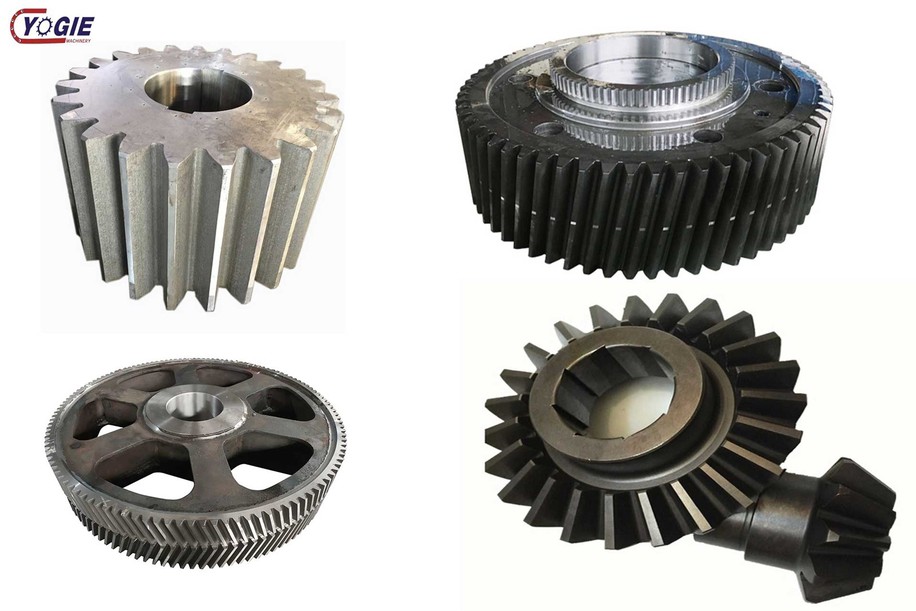
Industrial gear transmissions refer to mechanical systems used in industrial settings to transmit power from one rotating shaft to another. These transmissions utilize gears, which are toothed wheels, to transfer motion and torque between shafts. They are crucial components in various industrial machinery and equipment.
applications
Manufacturing Machinery: Gear transmissions are commonly found in manufacturing equipment such as conveyor systems, machine tools, and packaging machines.
Heavy Machinery: Industrial gear transmissions are integral to heavy machinery like mining equipment, construction machinery, and agricultural machinery.
Automotive Industry: Gear transmissions are widely used in automotive applications, including gearboxes in vehicles and transmission systems in heavy-duty trucks.
Power Generation: Gear transmissions play a vital role in power generation equipment such as wind turbines, hydroelectric generators, and steam turbines.
Marine Applications: In marine vessels, gear transmissions are utilized in propulsion systems to transfer power from engines to propellers.
Oil & Gas Industry: Gear transmissions are employed in various equipment used in the oil and gas industry, including pumps, compressors, and drilling rigs.
common types along with their advantages
Industrial gear transmissions come in different types, such as spur gears, helical gears, bevel gears, worm gears, planetary gears, and cycloidal gears, each suited for specific applications based on factors such as torque requirements, speed, direction of rotation, space constraints, and efficiency considerations. These transmissions are designed to withstand heavy loads, provide efficient power transfer, and ensure reliable operation in industrial environments.
Spur Gear transmission
1.Simple design and easy to manufacture.
2.Efficient power transmission.
3.Suitable for low to moderate speed applications.
4.Can handle high loads.
Helical gear transmission
1.Smoother and quieter operation compared to spur gears due to gradual engagement of teeth.
2.High efficiency.
3.Can transmit higher loads compared to spur gears.
4.Can be used for both parallel and right-angle shaft arrangements.
Bevel gear transmission
1.Used for transmitting power between shafts that are not parallel and intersect at an angle.
2.Efficient power transmission at right angles.
3.Compact design.
4.Suitable for high-speed applications.
worm gear transmission
1.High gear reduction ratios can be achieved with a single pair of gears.
2.Self-locking feature prevents reverse rotation, making them suitable for applications requiring holding loads.
3.Compact size compared to other types of gear arrangements.
4.High shock load resistance.
planetary gear transmission
1.High power density due to multiple gear sets sharing the load.
2.Compact design.
3.High efficiency.
4.Can achieve various gear ratios and configurations within a single gearbox.
5.Low backlash.
cycloidal gear transmission
1.High shock load capacity.
2.Compact design.
3.High efficiency.
4.Low noise operation.
5.High torsional stiffness.


