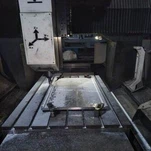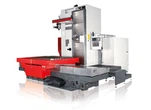


A large gear for a mining ball mill or a cement rotary kiln is not a catalog part. It is usually made to a customer drawing, in a diameter from one or two meters up to eight meters or more, weighing several tons to tens of tons, and often ordered in a quantity of one. That changes everything about how it is made. The foundry or forge must produce a single blank with sound internal structure, the machine shop must handle a part that is too big and heavy for standard equipment, and the heat-treatment shop must control distortion on a massive workpiece. For the buyer, the key is working with a manufacturer that can take the gear from raw material through final inspection under one roof, because moving a ten-ton gear between shops adds cost, delay, and risk.
Choosing The Right Process: Casting vs Forging
The first decision is how to make the blank. Casting is the standard route for very large girth gears and ring gears - molten steel is poured into a mold, and the resulting casting can be made in one piece or in segments. Casting has no practical upper size limit and allows near-net shape, but the solidification structure can contain porosity and shrinkage, so rigorous inspection is essential. Forging is used for smaller but heavily loaded gears and pinions where fatigue strength matters most. A forged blank is pressed under thousands of tons of hydraulic force, which closes internal voids and aligns the grain flow; fatigue strength can be roughly 30% higher than a cast equivalent of the same alloy. For a high-speed pinion or a gear that sees heavy shock loading, forging is usually worth the extra cost; for a slow-turning girth gear on a kiln, casting is the practical and economic choice.
Material Selection For Heavy Duty
Material is matched to the load, speed, and environment. The most common cast steel grades for large girth gears are ZG45, ZG35CrMo, and ZG42CrMo, with GS-34CrNiMo6 specified for higher-strength European-standard gears. Forged gears typically use 42CrMo, 40Cr, 34CrNiMo6, and - where surface hardening by carburizing is required - 20CrMnTi or 20CrMo. Ductile iron such as QT600-3 is sometimes used for large, slow-speed gears where cost and damping matter more than ultimate strength. The material decision should not be made on price alone: a gear that is too soft will pit and wear prematurely, while a gear that is too brittle can fracture under shock load. A reputable manufacturer will recommend the grade based on the actual duty, not just what the drawing says.
The Manufacturing Sequence
A large gear moves through a fixed sequence of operations. It starts with the blank - casting or forging - followed by rough machining on a vertical lathe that turns the faces, outer diameter, and bore to within about 0.2 mm, establishing the reference surfaces for everything that follows. Next comes tooth cutting, usually by gear hobbing for external teeth; hobbing can handle modules up to about 40, and gear milling up to 50 on very large gears. For internal gears or double gears, gear shaping is used instead. After heat treatment, hard-tooth gears go to gear grinding for the highest accuracy, while soft-tooth gears may be finished by shaving or honing to improve surface finish and reduce noise. Each step must be aligned to the same datum, because an error introduced in rough machining cannot be corrected later.
Heat Treatment And Tooth Hardening
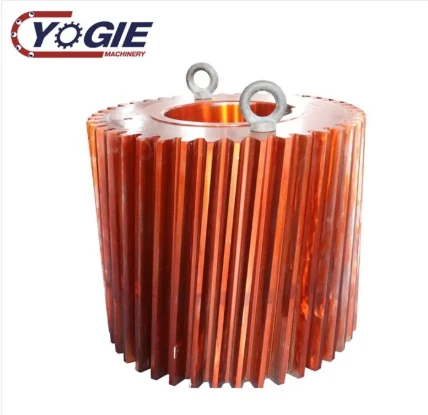
Heat treatment is where a large gear gains its real strength, and it is also where most problems originate if done wrong. Cast gears are typically normalized after casting to refine the grain and relieve solidification stress, then quenched and tempered to reach the required hardness and toughness. Forged gears go straight to quenching and tempering after rough machining. Tooth surfaces are then hardened by one of several methods: surface (induction) quenching for large gears where only the tooth flank needs hardness, carburizing and quenching for high-wear pinions using low-carbon alloys such as 20CrMnTi, or nitriding for gears that need a hard, wear-resistant surface with minimal distortion. The challenge on a large gear is distortion - a gear that moves during quenching may not grind clean, and a gear that is not stress-relieved can crack in service. Controlled heating, quenching fixtures, and tempering immediately after quenching are what make the difference between a gear that lasts decades and one that fails in months.
Accuracy, Inspection, And Standards
A large gear is only as good as its inspection. Dimensional accuracy is measured against standards such as ISO 1328, AGMA 2000, DIN 3962, or GB/T 10095, covering tooth profile, lead, pitch, runout, and backlash. On the material side, cast gears require ultrasonic testing (UT) to find internal porosity and magnetic particle testing (MT) to find surface cracks, especially in the tooth root area where fatigue cracks start. Forged gears are also UT/MT inspected, though they are less likely to contain volume defects. A serious manufacturer provides a full material certificate and inspection report with every gear, including heat-treatment records, hardness readings, and dimensional reports. A gear sold without these documents is a risk, not a bargain.
Segmented Construction For Very Large Gears
Beyond a certain diameter, a gear cannot be transported or even cast in one piece. Segmented girth gears are cast or forged in two, four, or six segments, machined individually, and then bolted together on site with fitted bolts and dowels. This approach is standard on very large rotary kiln and ball mill drives, where the gear may exceed eight meters in diameter and weigh more than a hundred tons. Segmented construction also makes replacement practical - if one tooth section is damaged, the affected segment can be unbolted and replaced without removing the entire gear. The critical requirement is that the mating faces between segments are machined to a high standard and that the bolt holes are line-reamed after assembly, so the gear runs true as a single circle.
Applications In Heavy Industry
Custom large gears are found wherever heavy rotary equipment must be driven at high torque and low speed. In mining, they drive ball mills, rod mills, crushers, and rotary dryers. In cement and lime, they turn rotary kilns, coolers, and vertical roller mills. In metallurgy, they drive converters, continuous casters, and rolling mill stands. In material handling, they form the slewing rings and drive gears of large cranes and ship unloaders. In wind power, forged gear rings and planet gears sit inside the gearbox that steps up rotor speed to generator speed. In every case, the gear is a critical component - its failure stops the machine, and its replacement costs weeks of downtime plus the price of the gear itself.
Conclusion
Custom large gear manufacturing for heavy industry is a combination of metallurgy, machining, and quality control that few shops can do well end to end. The right process - casting for very large girth gears, forging for heavily loaded pinions and smaller gears - matched to the right material and the right heat treatment, produces a gear that runs for decades under shock and high torque. Accuracy standards and UT/MT inspection are not optional extras; they are what separate a reliable gear from a casting that may fail without warning. For the buyer, the safest choice is a manufacturer that controls every step from raw material to final inspection and can deliver the certificates to prove it.