

A gear ring can be made in two fundamentally different ways. Forging starts with a heated steel billet that is plastically deformed under pressure - for rings, usually on a ring-rolling mill that stretches the billet into a seamless, concentric ring. Casting starts with molten steel poured into a mold, where it solidifies into the ring shape. Both routes end up at a gear blank that is then machined and heat-treated, but the internal structure of the metal is completely different, and that difference determines how the ring performs under load, how long it lasts, and what it costs.
Internal Structure: The Real Difference
The most important difference is not visible from the outside. A forged ring has a dense, wrought structure with near-full density - typically around 99.8% - and the compressive forces of forging close up any small voids that existed in the starting billet. The metal grain flow is elongated and runs circumferentially, following the contour of the ring and the direction in which the gear teeth will be loaded. A cast ring solidifies from liquid metal, so its grain structure is dendritic and random, and it can contain porosity, shrinkage cavities, and inclusions - density is usually below 98%. These internal voids are where fatigue cracks start. For a gear ring that sees millions of load cycles, a dense, grain-aligned structure is a direct advantage.
Mechanical Properties: Numbers Tell The Story
Because of that structural difference, forged and cast gear rings show a clear gap in mechanical properties, even when made from the same alloy grade. For a typical alloy steel such as 42CrMo, a forged ring after quenching and tempering reaches tensile strength of roughly 950–1100 MPa, yield strength of 600–900 MPa, and impact toughness of 40–80 J at −40°C. A cast steel ring of comparable chemistry reaches about 800–950 MPa tensile, 300–450 MPa yield, and 10–25 J impact at the same temperature. Fatigue life is where the gap matters most: forged rings typically last two to three times longer under cyclic loading, with contact fatigue limits 20% higher and bending fatigue limits 15–30% higher than cast equivalents. In field service, forged gear rings often run 1.5 to 2 times the service life of cast rings in the same application.
Size And Geometry: Where Casting Wins
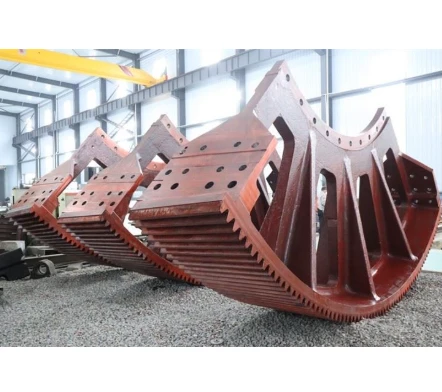
Forging is not always the better choice, and the first limitation is size. Ring-rolling mills and forging presses have an upper limit on diameter and weight, so very large gear rings - the girth gears that drive rotary kilns, ball mills, and large dryers, often several meters to over ten meters in diameter - are simply not practical to forge. Casting has no such limit, and very large rings can be cast in one piece or in segments that are bolted together for transport and installation. Casting also allows near-net-shape geometry, including ribs, bosses, and complex cross-sections that would require heavy machining from a forged blank. For a slow-speed, high-torque girth gear on a cement kiln, a cast steel ring is often the engineering and economic choice.
Cost And Lead Time
Forged rings are more expensive per kilogram of finished part. The forging process itself requires tooling, presses, and ring-rolling equipment, and the blank typically has a larger machining allowance because it is not near-net shape - material utilization is lower, and more hours go into machining. Cast rings use material more efficiently, can be produced with less machining, and are generally cheaper in medium and large sizes, especially when the design is already established. Lead times follow the same pattern: a cast ring can often be produced and shipped faster than a forged equivalent, particularly for large diameters where forging capacity is booked far in advance. The trade-off is that the buyer pays more for a forged ring but gets a longer-lived, more fatigue-resistant part.
Application Matching
The right choice depends on the duty. Forged gear rings are preferred where reliability and fatigue life dominate: wind-turbine gearboxes, mining haul-truck wheel drives, aerospace and defense transmissions, high-speed gearboxes, precision machine tools, and heavily loaded pinions and small gear rings. In these applications, an unplanned failure is expensive and the load is cyclic and often high-speed. Cast gear rings are the practical choice for very large, slow-speed, high-torque drives: girth gears on rotary kilns and ball mills, large sugar mill drives, dredge wheels, and heavy crane slewing rings. Modern cast steel, when properly normalized, annealed, and quenched-and-tempered, can deliver tensile strength and impact toughness that approaches a forged ring of the same grade - but it cannot match the fatigue life and internal density of a properly forged part.
Heat Treatment And Quality Control
Both processes rely on heat treatment to reach final properties, and quality control is where a good supplier separates from a poor one. Forged rings are typically normalized after forging, then quenched and tempered to achieve the required hardness and toughness, and many buyers require ultrasonic testing (UT) and magnetic particle testing (MT) on 100% of production to confirm there are no internal or surface defects. Cast rings require normalizing and annealing to refine the cast grain and relieve residual stress from solidification, followed by quenching and tempering; because castings are more likely to contain hidden porosity, radiographic or ultrasonic inspection is even more important. A cast ring that skips proper heat treatment or inspection is a much riskier part than its spec sheet suggests.
Conclusion
There is no universal winner - the better gear ring is the one matched to the application. Forged rings win on internal density, grain flow, strength, impact toughness, and especially fatigue life, making them the right choice for high-speed, heavily loaded, reliability-critical drives where a failure is costly. Cast rings win on maximum size, complex geometry, near-net-shape material utilization, and cost, making them the practical choice for very large, slow-speed girth gears on kilns, mills, and heavy process equipment. Modern heat treatment and inspection narrow the performance gap, but they do not erase it. The decision should be driven by load, speed, size, and the cost of downtime - not by which process sounds stronger in a sales brochure.