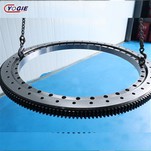


Relations between heat treatment and large gear shaft in industry

Description
Heat treatment plays a crucial role in the production and performance of large gear shafts in the industry. Here are some key relations between heat treatment and large gear shafts:
Hardness and Strength: Large gear shafts are subjected to significant mechanical stresses during operation. Heat treatment processes like quenching and tempering can increase the hardness and strength of the gear shaft material. This ensures that the gear shaft can withstand heavy loads, resist wear, and maintain its integrity under demanding conditions.
Wear Resistance: Large gear shafts often operate in harsh environments where they encounter friction and abrasive forces. Heat treatment methods like case hardening, such as carburizing or nitriding, can create a hardened outer layer that provides excellent wear resistance. This helps to extend the lifespan of the gear shaft by minimizing surface damage and reducing the need for frequent replacements.
Fatigue Resistance: Gear shafts are subjected to cyclic loading, which can lead to fatigue failure if the material is not properly treated. Heat treatment processes, such as controlled cooling and tempering, can enhance the material's resistance to fatigue by optimizing its microstructure and reducing internal stresses. This improves the gear shaft's durability and prolongs its service life.
Dimensional Stability: Large gear shafts require dimensional stability to ensure precise gear meshing and smooth operation. Heat treatment, specifically stress relieving, helps to relieve residual stresses that may have been induced during machining or welding processes. This minimizes distortion and maintains the dimensional accuracy of the gear shaft, ensuring proper gear alignment and reducing noise and vibration during operation.
Machinability: Heat treatment, specifically annealing, can improve the machinability of large gear shafts. Annealing softens the material, making it easier to cut, shape, and machine. This enhances the manufacturing process by reducing tool wear, improving surface finish, and enabling more efficient production.
Quality Control: Heat treatment is a critical step in the manufacturing process of large gear shafts. Proper heat treatment techniques, along with accurate temperature control and quenching methods, ensure consistent and uniform material properties across the gear shaft. This facilitates quality control and helps meet the required specifications and standards.
Summary
Overall, heat treatment is essential for large gear shafts as it provides the necessary properties for optimal performance, including hardness, strength, wear resistance, fatigue resistance, dimensional stability, and machinability. It ensures that gear shafts can reliably transmit power, withstand heavy loads, and operate efficiently in industrial applications.