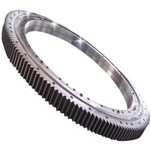


Slewing ring bearing
Slewing ring bearings are usually composed of four major parts: inner ring, outer ring, rolling element, and spacer block. Since the core component adopts slewing bearing, it can bear axial force and radial force at the same time. There are many forms, but the structure and composition are basically the same.

From left to right are (upper part): 1. Outer ring (with or without teeth) 2. Sealing band 3. Rolling element (roller or roller) 4. Fuel nozzle
From left to right are (the lower part): 1. Plug 2. Taper pin 3. Inner ring (with or without teeth) 4. Isolation block or cage 5. Mounting hole (wire hole or smooth hole)
Application of slewing bearing
Construction machinery:
Slewing bearings have a wide range of applications. Construction machinery is the first and most widely used place for slewing bearings, such as earthmoving machinery, excavators, dismantling machines, stackers and reclaimers, graders, road rollers, dynamic compactors, rock drilling machines, and roadheaders

Other mechanical equipment:
In addition to various engineering machinery, the application range of slewing bearings has gradually expanded. Equipment platforms such as port equipment, metallurgical equipment, and drilling platforms have begun to use slewing bearings instead of original bearings on a large scale.