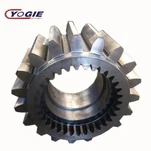


The suitability of carburizing, nitriding, and surface quenching for gears depends on various factors, including the application, material, and desired properties. Here's a brief overview of each process and its suitability for gears:
Carburizing
1. Carburizing is a heat treatment process that involves introducing carbon into the surface of a metal (typically low-carbon or alloy steel) to improve its hardness and wear resistance.
2. Carburizing is commonly used for gears, especially for applications where high wear resistance and fatigue strength are required.
3. It forms a hardened layer on the gear's surface, which can withstand the repetitive contact and sliding typical in gear applications.
4. Carburizing is particularly suitable for gears in high-load and high-wear environments, such as those found in automotive and industrial gear applications.
Nitriding
1. Nitriding is a surface-hardening process that introduces nitrogen into the surface of steel or other iron-based alloys. It forms hard nitrides, enhancing surface properties.
2. Nitriding is suitable for gears that require excellent wear resistance, improved fatigue strength, and resistance to scuffing and galling.
3. It is commonly used for gears operating at moderate to high temperatures, where maintaining dimensional stability is crucial. However, it may not provide as much depth of hardness as carburizing.
surface quenching
1. Surface quenching is a heat treatment process in which only the surface of a component is heated and then rapidly cooled to harden the outer layer.
2. Surface quenching can be suitable for gears that need localized hardening or where precise control over hardness and case depth is required.
3. It may be employed for specific gear applications, such as selective hardening of gear teeth, to achieve the desired combination of hardness and toughness.